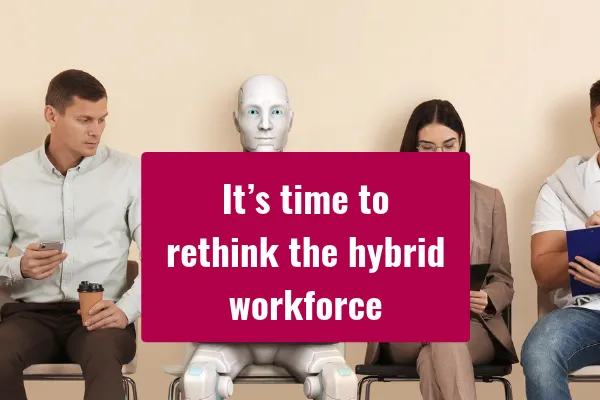
AI and Humans in the workforce
Hybrid describes where we work, but we now need to consider describing it as who, and what, does the work. Somebody has to design it.
For the past few years, the conversation about hybrid working has been similar:
How many days should employees spend in the office?
Are people more productive at home?
Should organisations mandate a return to the workplace?
We've spent a long time debating where work happens but whilst that debate has continued, something more fundamental has started to change: The nature of the work itself.
AI agents can now take on tasks and increasingly complex workflows. That means that work will no longer be done exclusively by people.
There is a growing tendency to describe what could come next as humans and AI agents start to work together. I do understand the appeal but it's a simple way to explain a complex change that we may not be ready for.
It misses the bigger opportunity.
A hybrid workforce is work deliberately redesigned around people, automation and AI agents, with a named human accountable for every outcome.
It is not simply a team of people and agents working alongside one another. It is a different way of thinking about how work is redesigned, distributed, managed and valued.
If HR doesn't start leading that conversation, somebody else will.
We've been asking the wrong questions about AI
For the last three years, much of the conversation about AI and employment has revolved around one question.
Will AI replace people?
It generates headlines, fuels anxiety and keeps commentators busy predicting which professions disappear next. HR has not, and will not, escape the speculation. We've heard AI will replace recruiters, automate HR admin and make L&D redundant. And, inevitably, we've been told the answer is to learn how to prompt and use AI more effectively.
I think that distracted us from a far more important question.
If organisations can now get work done through a combination of employees, technology, automation, AI agents and external expertise, how should that work be organised?
That is a fundamental workforce question. And workforce planning questions belong at the heart of HR.
Here we go again
Every era of work reaches a moment when someone has to redesign it. The only question is who.
In the 1950s, Eric Trist and Ken Bamforth studied British coal mines that had introduced mechanised methods. The technology worked. The work around it didn't. Those close knit teams were broken up and the expected gains didn't arrive.
In 1990, Michael Hammer told managers in Harvard Business Review not to automate old processes but to obliterate them. Business process reengineering followed. All too often it because a headcount exercise.
More recently, John Boudreau and Ravin Jesuthasan have argued that we should break jobs into tasks and rebuild work around what people, automation and other sources of talent each do best.
I'm building on all of it and thinking about what my 36 year HR career has taught me.
Work design, workforce planning, process redesign, Six Sigma and the HR business partner model are not new ideas and for sure I am not claiming they are.
What is new is the technology. A tool waits to be used. An agent acts. It can start a task, decide within its permissions and trigger the next step. It changes the design problem and raises the stakes.
We are in a new era, and that new era needs new assumptions about work. In earlier eras, the redesign was too often led by people who understood the technology better than the work. HR can do it differently this time.
From managing jobs to redesigning the work
So far, hybrid has meant two things: Where we work and now humans plus AI. One asks where the work happens. The other who, or what, performs it. Neither have asked whether the work is designed in the right way.
Think about how organisations operate today. We create jobs. We group tasks and activities into job roles. We recruit people to fill them. We set reporting lines, objectives and development plans. The whole structure assumes work is done by people in positions, with tech something they use.
But what happens when technology can undertake activities independently, manage parts of a process, spot when something needs intervention and coordinate actions across systems?
The question is no longer whether an employee could do their existing job faster with AI. It is whether we would design that job, or that function, the same way if we were starting again today.
Take onboarding. HR administrators, hiring managers, IT, payroll, facilities, learning teams. Forms, systems, equipment, comms, training and a lot of chasing. Likely using a spreadsheet.
An obvious move is to give the HR administrator Copilot to draft emails, produce checklists and summarise information. Useful? Absolutely. I know, I train people on how to do it. Transformational? Not really. The same handovers remain; the same frustrations; the same delays. All we have done is made individual activities faster.
Now start by mapping the whole experience and asking:
Which activities need human judgement or interaction
Which are repetitive, rules-based or administrative in nature?
Where might an AI agent coordinate activities, monitor progress or flag exceptions?
Where must a named individual keep authority and accountability?
Which parts should become more personal, not more automated?
Much of the administrative coordination could be redesigned. The HR team could give more attention to helping new employees settle in, supporting managers and spotting issues that affect the employee experience.
The work hasn't disappeared. Where human effort adds the most value has moved.
That is what a hybrid workforce looks like. Not humans over here and agents over there. A deliberately designed system.
An HR team I worked with were proud that Copilot had halved the time it took to draft onboarding emails. But the chasing hadn't gone anywhere. So we automated the tracking and let an agent flag anything late. The administrator spend the freed time phoning every new starter on day three. One of them said they hadn't spoken to anyone on her team yet. Her manager called her within the hour.
THAT CALL is where human effort adds the most value.
Not an employee. Not just a tool.
We're hearing more about AI agents as digital employees, digital colleagues, members of the workforce. Some of that language is useful. It reminds businesses that autonomous systems need oversight, clear boundaries and accountability.
But an agent is not an employee and we would do well enough to remember that.
It has no employment rights, yet. It has no personal aspirations, dignity or career ambitions. Equally, it does not build trust, experience culture or feel the consequences of a decision. It can simulate empathy quite convincingly. That is not the same as experiencing empathy or accepting moral responsibility.
Having worked with hundreds of HR professionals on AI, I've heard the same concern again and again: Can these systems understand the nuances of people and organisations? It deserves a serious answer.
"Not an employee' is only half of the story.
An agent is not just a tool either. A tool waits for you to pick it up. An agent, as I have said, reads, decides, drafts, sends, updates records and triggers the next step. So HR can't stop at "it isn't one of ours" as a defence. We have to look at what it is actually doing.
For every agent, that means being able to answer:
What is it for, and who asked for it?
What can it access, and what can it change?
What can it decide alone, and what needs a person?
How is it tested before it goes live, and how often afterwards?
Who can see what it did, and who steps in when it goes wrong?
When does it stop?
Pause and read that list again.
Purpose, access, authority, probation, performance review, escalation, leaving.
HR has asked these questions about people for decades. We now need to ask them about agents too.
Employees need leadership, development, wellbeing support, fair treatment and meaningful opportunities. Agents need defined purposes, permissions, monitoring, testing, escalation routes and clear accountability for what they do.
These are parallels. They are also fundamental differences.
Treating humans and agents as interchangeable is a mistake. Ignorning what agents do is an even bigger one.
This changes the role of HR even more than we might realise
For years, HR has been working to secure its position as a strategic function. We've talked about earning a seat at the table and becoming commercial partners.
The changing nature of work offers something beyond that. HR could help organisations decide how work should be designed in the first place.
That means being involved in decisions that have traditionally sat elsewhere. Consider the questions organisations will increasingly need to answer.
Workforce planning
If certain activities can be undertaken through automation or AI agents, how should that influence future workforce requirements?
Do we replace a vacancy like for like, redesign the role or reconsider how the entire process operates?
Organisational design
If work can be coordinated across humans, automated systems and AI agents, do our existing organisational structures still make sense?
Could we need different team configurations, management responsibilities or decision-making arrangements?
Capability development
If employees spend less time producing information and more time interpreting, challenging and acting on it, what capabilities become more valuable?
How should learning, development and career progression change?
Performance management
If an outcome is produced through a combination of human effort, automation and AI supported activity, how can we evaluate performance fairly?
How do we distinguish individual contribution from the capability of the wider system?
Employee experience
If employees increasingly work through AI-enabled processes, how do we protect autonomy, trust, meaningful work and opportunities to develop?
How do we make sure increased efficiency doesn't simply result in greater workloads?
Governance and accountability
Who decides which activities can be delegated to AI?
Who approves an AI agent's authority to act?
Who intervenes when something goes wrong?
And how do we ensure that a human remains accountable for decisions affecting people's employment and livelihoods?
These are not simply technology questions. They are questions about the design and management of work.
HR has a legitimate, important role in answering them. Not in isolation. IT, operations, finance, legal, risk and business leaders all bring essential expertise. But HR should be helping shape the decisions, not managing the people consequences afterwards.
Where HR already holds the pen
Some of this is not up for debate. It already sits in HR's territory, whether or not anyone has said so. Don't quote me on the legislation:
Employment law and equality. Decisions about who is hired, how performance is judged and who is selected for deployment or redundancy and the like carries legal duties. It makes little difference whether a person or an agent produced the recomendation.
Data protection. The UK data protection law sets conditions on decisions solely by automated means. An agent working with people data is inside that scope.
Regulation beyond the UK. We have the EU AI Act and if your organisation has EU employees, candidates or operations, that matters. Now think about country specific regulations.
Consultation and employee voice. Redesigning work can trigger informationa nd consultation duties, including collective consultation.
Employees will ask what an agent is doing with their data and whether it is making decisions about them. We had a long debate about consent to process employee data through AI last week during a training session. HR needs to be able to answer that question.
The risk is we repeat an old pattern
HR has lived through significant workplace transformations before.
Each created an opportunity to influence how organisations operate. Yet too often we became involved once the big decisions had been made. Technology purchased. A process redesigned. An operating model agreed. Then HR is asked to implement, communicate, arrange training and manage concerns.
Yes, those activities matter but they are not the same as shaping the decision.
AI could follow exactly the same pattern.
The evidence suggests we are already in the room but my question is - what are we actually doing there?
Involved, but shaping? SHRM's August 24 survey of US HR leaders found 92% take part in AI implementation. But only 30% said they were actively involved in projects and contribution to decisions. More than one third reported limited or no theoretical understanding of AI. I hope those figures have changed now.
Roles are already changing. In a Gartner survey of HR leaders, 27% said their orgs had redefined roles because of AI in the past year, 24% had redeployed employees, and 10% said they had replaced some jobs with AI.
HR's own use is accelerating. Gartner reports AI adoption rose from 19% to 61% between 2023 and 2025. AI transformation is listed as a top priority within many organisations.
The measure is changing. Microsoft's 2025 Work Trend Index, introduces a "human-agent ratio" as a new organisational metric. It also reported a third of leaders anticipate reducing headcount, whilst 78% plan to hire for new AI roles.
The profession is being asked to step up. In April 2026, the CIPD said HR teams need to move from a supporting role to being an active partner in shaping AI decisions across organistions.
HR shouldn't just be asking how employees will adapt to AI. We should be helping organisations decide how AI will change work, and whether those changes are desirable.
That is a very different level of influence.
Productivity is not the same as progress
There's another uncomfortable question. What are we actually trying to achieve by introducing AI into the workforce?
Efficiency on its own is a limited ambition.
Imagine a HR department where AI cuts the time spent on routine activities by 30%. What happens to that capacity?
Does the organisation reduce headcount, increase the volume of work or expect everyone to produce more, faster?
They should be investing that time in better employee support, organisational development, workforce planning and management capability.
Those are deliberate choices. They shouldn't be made accidently.
If we are serious about redesigning work, we need to decide what we are redesigning it for. Lower costs may be one objective. So might better services, healthier workloads, stronger capability and more meaningful roles.
A hybrid workforce strategy has to be clear about those choices.
So what should HR do differently?
I don't think the answer is to rush out and draw an org chart full of AI agents. And I certainly don't think every HR professional needs to become an AI engineer.
But I do think we need to change the questions we bring into workforce conversations.
The opportunity is not to do toay's work with fewer people in less time. It is to create ways of working we couldn't achieve before.
An HR function that spends less time chasing information might spend more time supporting managers; a recruitment team that spends less time coordinating interviews might focus on candidate experience and quality of assessment; a learning team that spends less time producing generic materials might create personalised development experiences.
Those outcomes are not inevitable. They need conscious design decisions. That is precisely why HR needs to be involved.
The next evoluation of HR is about work, not technology
Sometimes I wonder whether we spend too much time trying to prove that HR understands AI but understanding the tech is just the beginning.
The reasl strategic value comes from understanding what it makes possible for the organisation, and helping leaders make intelligence choices about how work should change.
For me, that is the real opportunity in redefining the hybrid workforce.
Its not about treating agents as employees; or positioning the tech as a replacement for human capability. And it is most definetely not about reducing every workforce conversation to a calculation of how many jobs it can automate.
The future hybrid workforce won't be defined by how many humans work alongside how many AI agents. It will be defined by how intelligently we design work around the capabilities available, while staying clear about human responsibility, value and accountability.
That needs a different kind of workforce strategy. One that thinks beyond headcount, job descriptions and productivity measures, and beyond the assumption that the structures we have today are the ones we need tomorrow.
HR has spend decades building expertise in people, capability, organisational design, culture, performance and change. Those disciplines are not becoming less relevant. They are becoming much more important. We might just need to apply them differently.
A new era is starting. Either we step forward and help design it, or we wait until somebody else has and ask how we can help people adjust.
I know which role I'd rather see HR playing.
Perhaps its time we stopped asking what AI means for the future of HR and start asking what HR should mean for the future of work.
What would need to change in our profession for HR to lead the design of the hybrid workforce?
I'm Lorraine Hunt, founder of Rethink:Work. I work with HR professionals and organisations to move beyond simply using AI tools and start rethinking how work gets done.
If you're interested in the changing relationship between AI, HR and the future of work, follow along for more.
