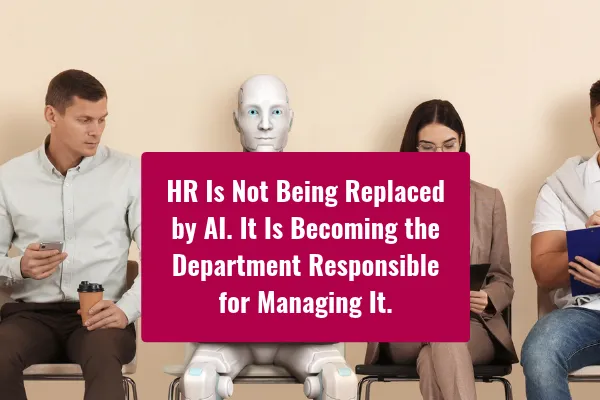
HR Is Not Being Replaced by AI. It Is Becoming the Department Responsible for Managing It.
The scare story about HR and AI has been the same for at least three years.
AI is coming for our jobs.
Learn to prompt or become irrelevant.
It is a small story dressed as a big one. It has never been the real conversation.
Here is the real one. HR is not being replaced by AI. HR is becoming the department responsible for managing it. That is a much bigger shift than replacement, and it is quietly the most important evolution of the profession since the introduction of HR systems.
Having taught hundreds of HR professionals now, one theme emerges consistently - AI cannot understand empathy, or understand and learn the nuances of HR.
The pattern the profession keeps repeating
HR has done this before. Every generation, a new capability arrives in the workforce, and HR either steps forward to own its people implications or lets someone else define them.
When workforce data first arrived, HR could have led. In many organisations, IT or finance stepped in first. HR spent years catching up.
When employee wellbeing became a strategic issue, HR could have led. In many organisations, marketing and internal communications got there first. HR spent years catching up.
When hybrid working landed, HR could have led. In many organisations, facilities and IT set the terms. HR spent years catching up.
The AI Workforce is the next test. If HR spends the next two years arguing about whether AI counts as a colleague, another function will define the answer for us.
What managing the AI Workforce actually means
It does not mean HR becomes technical.
It means HR applies the disciplines it has always applied - just to a new category of organisational contributor.
Role design: For humans and AI agents.
Onboarding: For humans and AI agents.
Performance management: For humans and AI agents.
Governance: Spanning humans and AI agents.
Culture, in a workplace where humans and AI agents work together.
Change leadership, for the organisation that has to adapt.
Retirement, done responsibly, for humans and AI agents.
None of that is new. All of it is HR. The only thing that changes is the population it applies to.
Why HR is the natural home for this
At least three reasons, although I am sure I could add many more. All of them are structural.
The first is craft. No other function has the practice of thinking about a workforce as a system. IT thinks in stacks. Legal thinks in risk. Finance thinks in cost. HR thinks in people, capability, relationships and outcomes. That mindset is what a hybrid workforce actually needs.
The second is trust. When decisions about work affect livelihoods, dignity or identity, people look to HR. That does not change when AI is involved. If anything, it becomes more important. HR is the function employees expect to protect their interests when new technology arrives.
The third is scope. HR already touches every other function through the people it employs. That gives it a natural line of sight into how AI is being used everywhere, which is exactly the line of sight the AI Workforce needs.
The reframing that unlocks the profession
Change one sentence in how you talk about your work and much else follows.
Stop saying HR is figuring out how to use AI. Start saying HR is the function that manages the AI Workforce. Unless you dont, of course.
That single sentence changes how you are heard in leadership meetings. It changes what you are invited to. It changes what your team spends its time on. It changes the questions vendors ask you. It changes the questions candidates ask you.
Small shift. Very different positioning.
What the next decade actually asks of HR
The next decade is not a technology decade for HR. It is a leadership decade.
HR spent the last century managing people. The next decade will be about managing people and intelligent digital workers together. Everything the profession has learned about roles, capability, performance, culture and change will be applied to a broader definition of what a workforce is.
That is a serious evolution of the profession. It deserves serious leaders inside it.
If you are reading this and quietly wondering whether you have a place in that future, the answer is yes, and it is the most interesting place HR has ever been.
What to do this quarter
Take three small actions.
Rewrite one paragraph of how you describe your own role. Make it reflect responsibility for the Hybrid Workforce, not just the human workforce.
Ask for a place in whichever forum in your organisation currently discusses AI. If none exists, start it.
Bring the language of the AI Workforce into your next senior meeting. Watch how it changes the conversation.
You do not have to be the loudest voice. You just have to be the one who is clear about what HR is now for.
Inside AI for HR is where I share 3 practical ways to use Copilot, give you 2 prompts to try and 1 HR process, redefined.
The Rethink:Work blogs provide me thoughts on how the profession is shaping this leadership role in real time. If you want to be part of that conversation, come and read the next one.
