Why Every HR Team Needs Digital Employees in 2027
In 2027, if your HR department only employs humans, you may already be behind.
That really does read as a strong statement. Trust me, it is meant to.
Increasingly, the pace at which digital employees are being deployed in real HR functions has moved faster than most news might suggest.
The organisations quietly doing this are not talking about it much. I wonder whether that is because, given the nature of the work human resources do, we are not talking about it much. The organisations I help and speak to are just getting on with it. The rest of the HR profession is still debating whether it is a thing that can actually help them.
What is a digital employee?
Before we get into that, let's start with what it is not.
It is not another chatbot bolted onto your intranet. It is not a workflow inside an HRIS. It is not a Copilot licence. It is not a wrapper around a large language model.
A digital employee is an AI agent that has been designed as a member of your workforce. That means it has six things.
Objectives. A defined role and the clear outcomes it is expected to deliver. Let's face it, a human needs objectives so why wouldn't an AI Agent need some too?
Permissions. Explicit access to specific systems, files and folders, with a written boundary on what it can and cannot touch or what actions it can or cannot take.
Memory. Enough context, safely stored, to do its work consistently over time.
Processes. A defined way it does the work, aligned to how your organisation and your HR team actually operates.
Accountability. A named human manager, an owner, an escalation path. Someone accountable for not only keeping the AI Agent up to date, but for keeping its knowledge data sources up to date too.
Measurable outputs. Success measures that are looked at regularly, not just at the point of implementation.
Miss any of the six, and you do not have a digital employee. You have a piece of ungoverned software that might be difficult to defend if it goes rogue.
What HR could hire tomorrow (ie your first Copilot HR Agent!)
Every HR team has candidates for this. If you have honestly mapped where the work goes, you already know where they are. If you haven't, you still know your biggest frustrations, your pain points, the things that keep you up at night.
An onboarding agent. Coordinates the arrival of new joiners across systems, communications, IT, managers, learning and paperwork. Frees the human onboarding team to design experience, not chase forms. Get the basics done first, then create a second onboarding agent that sits alongside your new employee to answer any queries and questions they may have.
A policy assistant. Answers most of the first-line policy queries employees ask. Escalates the nuanced ones to a human. Trains itself on the actual policy library, not a generic model. Start with your policies, then take your hr inbox and analyse it for trends and patterns in questions and start there.
A recruitment coordinator. Schedules interviews, handles candidate communications, keeps the ATS clean, and drafts rejection emails as well as offer paperwork. Lets the recruiters spend their time on candidate quality and hiring manager coaching.
A Learning & Development coach. Nudges the right person to the right learning at the right moment, tracks whether they applied it, and reports back to their manager in plain English.
A reporting analyst. Pulls, cleans and formats standard reports. Prepares an early draft of monthly and quarterly people packs. Sits inside your data governance, not outside it.
None of these are hypothetical. All of them exist in production HR functions right now. I know, I've been building them for organisations for the last since 2025.
None of this starts with switching on an agent or just building out a draft.
It starts with looking honestly at the work itself because let's face it, why would you want to build an AI Agent on top of a broken process? That being said, if you know your process works brilliantly, then go for it.
This is my REWORK™ method in practice:
Review, Eliminate, Workflow, Optimise with AI, Roll Out, Keep Evolving.
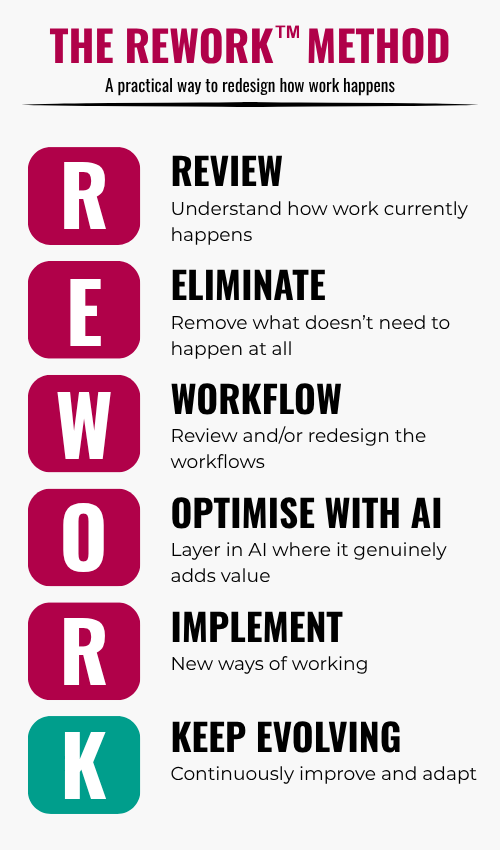
Skip the first four steps and you have not hired a digital employee.
You have automated a broken process and given it a fancy job title.
Every example AI Agent above only works because someone reviewed the role first, cut what did not need doing, mapped the workflow that was left, and only then decided where AI actually belonged in it.
The governance conversation to have first
Before you deploy any of these, spend a week asking yourself six things.
Governance. Which principles will guide what your digital employees can and cannot do?
Security. How is their access managed? How do you switch one off in a hurry? How do you escalate an issue?
Audit trails. What is logged? Who reviews the logs? How often? What actions do they take?
Ownership. Who has authority over each digital employee? Who is accountable for its outcomes?
Performance measures. What does good look like? What triggers a review?
Supervision. How much human oversight is in place? How does that change as trust is built?
Do not let a vendor tell you these can wait.
They cannot.
And they will define the difference between a digital employee that supports your organisation and one that quietly creates a legal or reputational problem.
What changes for the human team?
Introducing digital employees changes the human team, and pretending it does not is the fastest way to lose their trust.
Some human roles get smaller. Some grow. Some change shape. Some new ones appear.
The right response is to be transparent from the start. Talk about the Hybrid Workforce. Talk about what the humans in the team will do instead. Redesign their objectives to reflect it. Rebuild their development plan to grow the capabilities the redesign asks of them.
The teams that navigate this well end up with higher-value work, less drudgery and a genuinely stronger identity. The teams that avoid the conversation end up with confusion, cynicism, and a much slower rollout.
The bigger promise for HR
Every HR team is quietly stretched. Too much to do. Too little time. Too many stakeholders. Too many tools. Too many priorities. Too many missed opportunities to be more strategic.
Digital employees are the first genuinely serious way to release that pressure without either cutting the standard of work or cutting the human team.
Done well, they take routine work off the table so the humans can do work that is worth their pay grade.
Done well, they let HR say yes to strategic work it has been too busy to touch.
Done well, they turn the AI Workforce from a distant idea into a practical asset your function starts to rely on.
None of this happens by accident. It happens because HR leaders choose it and design it that way, deliberately, not by accident.
The invitation
You do not need permission to deploy your first digital employee. You need clarity on the role, the governance, the owner and the measures. Then you need the courage to run it in parallel with your current process for one month and to look honestly at what happens.
Do that once, and you begin to understand what a Hybrid Workforce actually feels like. Do it three times, and you become the HR function other functions come to for advice.
HR has spent decades managing people. The next generation of HR leaders will also manage digital employees. That is a genuinely exciting piece of work, and it is available now.
Every Wednesday, Inside AI for HR gives you three things to do with Copilot, two prompts worth stealing, and one workflow you can build before Friday.
